







By Joseph muyingo
Victoria University has grown into an important player in Uganda’s higher education sector, providing thousands of young people with opportunities to acquire professional skills and prepare for the changing demands of the job market.
The university is part of the Ruparelia Group, founded by businessman and investor Dr. Sudhir Ruparelia, who acquired Victoria University in 2013 with a vision of strengthening its identity and expanding its contribution to Uganda’s education sector.
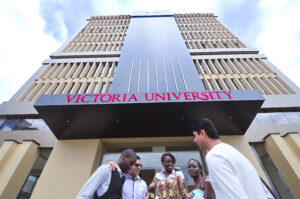
Under the Ruparelia Group, education has become one of the key areas of investment, alongside real estate, hospitality, agriculture and other sectors. Victoria University complements the Group’s other education institutions, including Kampala Parents’ School, Kampala International School Uganda and Delhi Public School International.
One of the university’s key strengths has been its emphasis on practical, innovative and employability-focused education. Its approach seeks to equip graduates with skills that can be applied beyond the classroom, particularly as Uganda’s economy increasingly demands professionals capable of adapting to technology and changing workplace requirements.
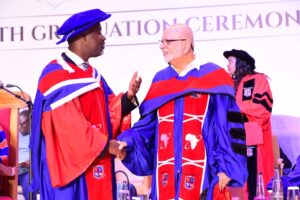
The university’s growth has also been reflected in its graduation numbers. At its ninth graduation ceremony in 2025, 2,029 students graduated with degrees, diplomas and certificates in fields including law, nursing and midwifery, journalism and mass communication, among others.
Investment in the future
Perhaps one of the most notable aspects of the Ruparelia family’s involvement in Victoria University is its focus on making education more accessible.
In 2025, Dr. Sudhir Ruparelia and his wife Jyotsna announced 100 fully funded Master’s scholarships for outstanding graduates in memory of their late son, Rajiv Ruparelia. The initiative was designed to give high-performing students an opportunity to advance their education and develop specialised skills.
The scholarships underline a broader philosophy of investing in people—not simply infrastructure. By supporting students to progress from undergraduate to postgraduate education, the initiative has the potential to create a pool of highly skilled professionals who can contribute to Uganda’s development.

Victoria University has also received a university charter from Uganda’s National Council for Higher Education, further strengthening its position within the country’s higher education system.
For Sudhir Ruparelia, whose investments span several sectors of the Ugandan economy, Victoria University represents more than another business venture. It is part of a wider investment in human capital, skills development and the future of Uganda’s young population.
As Uganda seeks to create more jobs, strengthen professional skills and prepare its youth for an increasingly digital economy, institutions such as Victoria University are positioned to play an important role in bridging the gap between education and the workplace.
**The story of Victoria University is therefore not only about a university—it is about an investment in people, skills and the next generation of Uganda’s workforce.**